What Should a Piano Student Write in a Practice Log Besides Minutes Played?
Minutes tell you that practice happened. A few extra lines tell you what changed. Here is what to record so the log becomes useful to you and your teacher.
Start with what you worked on, not how long
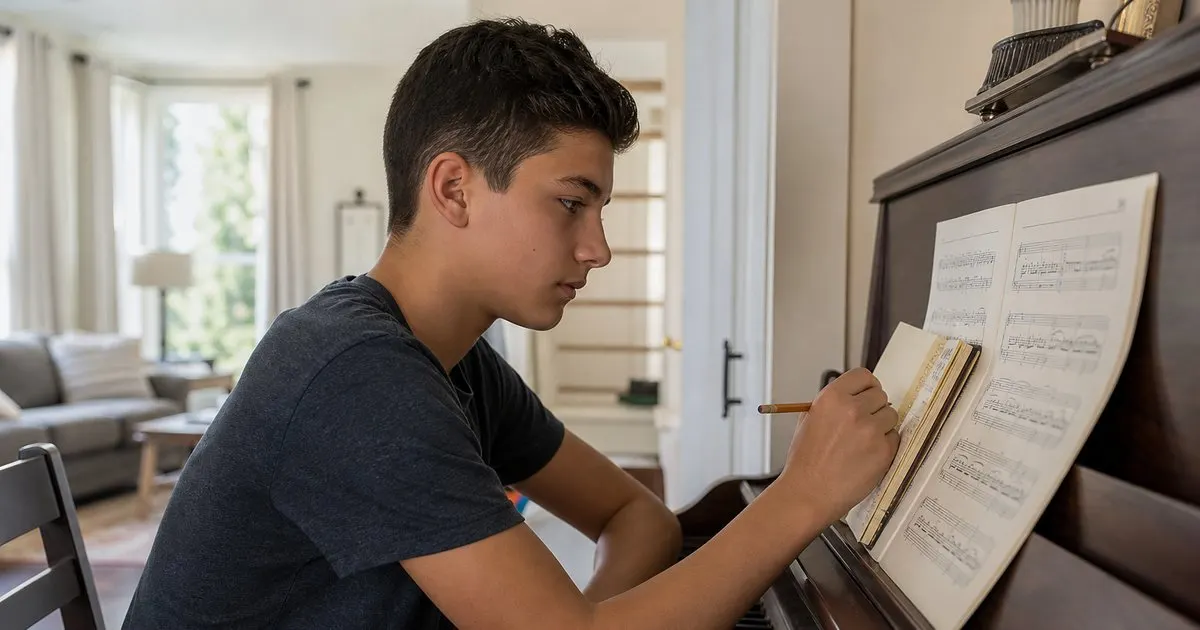
The single most useful line in a practice entry names the specific material: measures 17 through 24 of the left hand in a sonatina, the B-flat major scale hands together at a slow tempo, the pedal change in the second phrase of the recital piece. "Practiced piano, 30 minutes" tells a teacher nothing they can act on. "Left hand alone, measures 17 to 24, four repetitions each at 60 and 72" tells them exactly where the student's attention went and whether the assignment was understood. Related: How Should a Music Teacher Set Weekly Practice Goals for Beginners?
A helpful habit is to write the entry before the session, as a plan, and then adjust it after. Students who write "goal: get the ornament in measure 9 clean" and later add "got it three times out of five" are doing something much closer to deliberate practice than students who simply start a timer. The plan does not need to be elaborate. Two or three targets is plenty for a typical session, and beginners often do best with one. Related: How Can Students Build a Daily Practice Habit That Actually Sticks?
Keep reading: How Can Students Build a Daily Practice Habit That Actually Sticks?, What Makes a Practice Streak Motivating Instead of Stressful for Young Learners?, Why Does Logging Practice Time Improve Progress in Music and Sports?. See how PracticeLoggr helps you music and sport practice logging for students.
Record the tempo, the mistake, and the fix
Tempo markings are the cheapest objective data a pianist can log. Writing the metronome setting for each passage turns a vague sense of "it's getting better" into something you can read back a month later. If the passage was at 60 in week one and 84 in week four, that is progress you can see even on a day when the piece still feels shaky. If the number has not moved in three weeks, that is a signal to change the approach rather than keep repeating it.
Next to the tempo, note the specific error and what you tried. "Kept missing the leap in measure 12, tried stopping on the low note and looking ahead" is worth far more than "measure 12 is hard." Teachers read that kind of line and immediately know whether the student is using a sensible strategy or needs a different one. Over time, students start recognizing their own patterns, such as rushing at every crescendo or tensing before every octave passage, which is the real payoff of writing mistakes down. Related: When Is Practice Quality More Important Than Total Minutes Logged?
Add a short line about how it felt
A one-sentence mood or energy note sounds soft, but it explains a lot of the variation in a log. "Tired after swim practice, only did scales" or "focused, best session this week" gives a teacher context for why Tuesday looked thin and Thursday looked strong. It also helps students notice when they consistently practice well and schedule the harder work into those windows.
Keep this honest and short. The point is not to write a diary, and students who feel they have to produce a paragraph will stop writing anything. A single word, a number on a scale the student chooses, or a quick phrase is enough. In PracticeLoggr we kept the "how did it go" field to one line for exactly that reason, because the entries people actually fill in are the ones that take seconds.
Write one question for your next lesson
The most underused line in any practice log is the question. Students hit a fingering they cannot solve, a rhythm they are not sure they are reading correctly, or a dynamic marking they do not understand, and by the time the lesson arrives a week later they have forgotten it. Writing "ask about the fingering in the descending run, measure 22" preserves the question and typically makes the next lesson more productive than one that starts with "so, how did it go?" Related: What Makes a Practice Streak Motivating Instead of Stressful for Young Learners?
Teachers who see these questions ahead of time can prepare, and students who arrive with questions tend to be more engaged in the lesson itself. If a log is shared with the teacher, the question line becomes a natural agenda. If it is not shared, students can simply read their own questions back the night before. Either way, the log stops being a record of the past and starts shaping what happens next.
- Name the exact passage or exercise in every entry, not just the instrument and the minutes.
- Log the metronome tempo so progress becomes visible even on frustrating days.
- Write the mistake and the strategy you tried, which teaches you to spot your own patterns.
- End each entry with one question for the next lesson so nothing gets forgotten.

Julien Jimenez
Julien Jimenez is an independent software builder based in Paris. He designs, ships, and operates focused SaaS products for small businesses and independent professionals. Read the full author page.
Turn daily practice into visible progress
Music and sport practice logging for students. PracticeLoggr is built to help you put this into practice.
Start a practice logMore from the PracticeLoggr blog


Get the PracticeLoggr playbook
Practical guides on practice logging, straight to your inbox as we publish them. No spam, unsubscribe any time.